
In The Name of Allah, The Compassionate, The Merciful. Lady Fatima al-Zahra (a.s.): A Symbol of Purity and a Role Model for All
In The Name of Allah, The Compassionate, The Merciful.
Lady Fatima al-Zahra (a.s.):
A Symbol of Purity and a Role Model for All
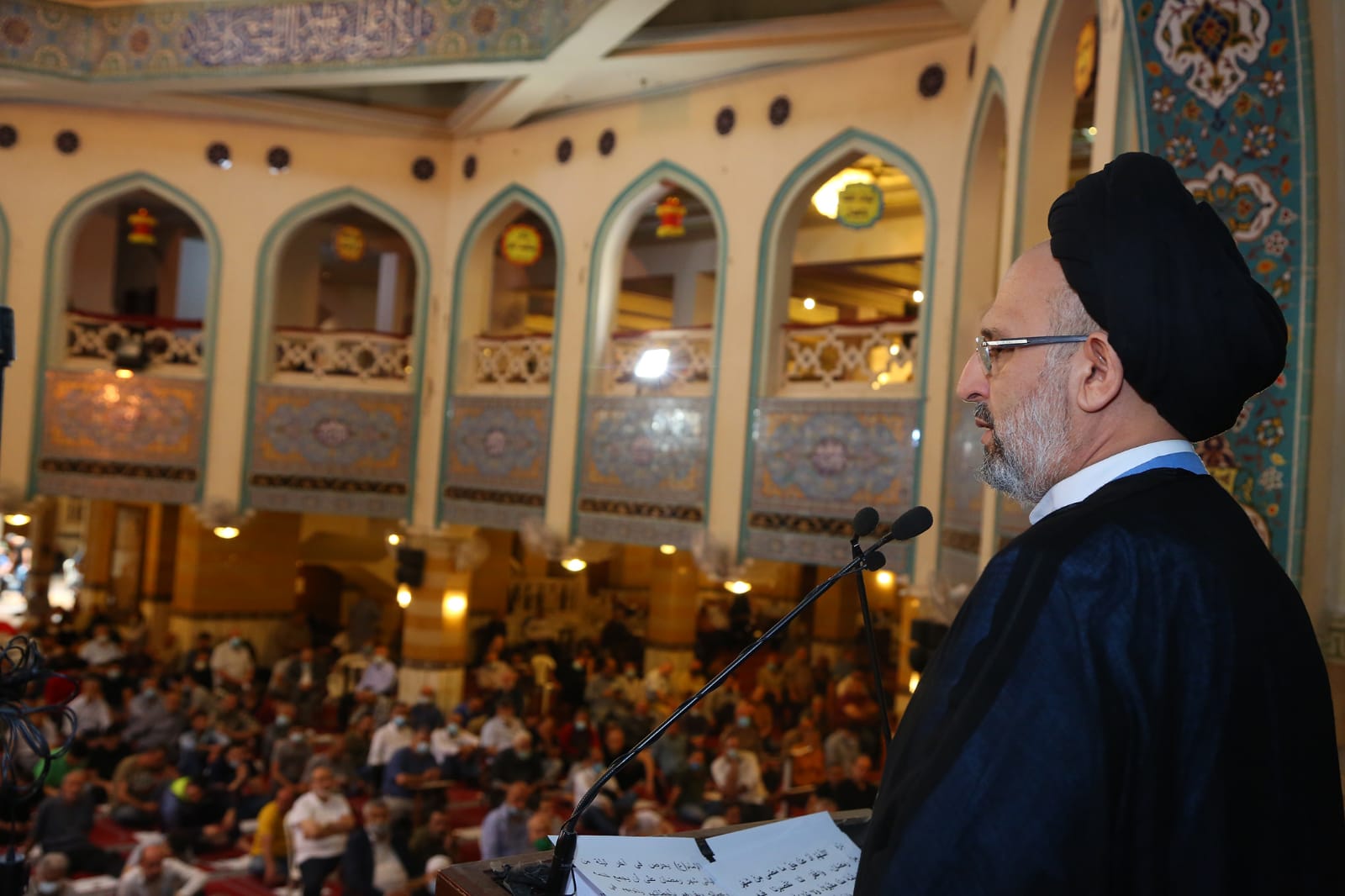
His Eminence, Sayyed Ali Fadlullah, delivered the two Friday prayer sermons at the Imamain Al-Hassanain Mosque, Jamada II 22, 1445 /December 12, 2023. Several prominent religious scholars, dignitaries, and hundreds of believers attended the Jumu’a prayer. Following is a summary of the sermons.
Allah, the Most Exalted, says in His Noble Book:
“Indeed, Allah only desires to remove impurity from you, O People of the Household, and to purify you completely.”
Allah, The Most Exalted, has spoken the truth.
On the twentieth of Jumada al-Thani, we commemorated the blessed anniversary of the birth of the pure and utterly truthful Lady Fatima al-Zahra (a.s.), the Leader of the Women of the Worlds. She attained such a lofty rank and position with Allah, the Most Exalted, that she was among those from whom He removed impurity and purified completely.
She was honored by the Messenger of Allah (p.), who said:
. “ Fatima is a part of me. Whoever pleases her pleases me, and whoever harms her harms me. Fatima is my heart and my soul between my sides.”
It is narrated from Aisha, the wife of the Messenger of Allah (p.), that she said:
“I never saw anyone more beloved to the Messenger of Allah (p.) than Fatima.”
Whenever Fatima (a.s.) entered upon him, the Messenger of Allah (p.) would take her hand, kiss it, and seat her beside him. When he returned from a battle or a journey, he would pray two units of prayer in gratitude to Allah, the Most Exalted, for his safe return, then go to the house of Fatima (a.s.).
This great honor was not rooted in emotion alone, for the Messenger of Allah (p.), as Allah, the Most Exalted, says:
“Nor does he speak from [his own] inclination.
It is not but a revelation revealed.”
(Qur’an 53:3–4)
Rather, it was due to the qualities Lady Fatima al-Zahra (a.s.) embodied and the role she played throughout her life. For this reason, the Messenger of Allah (p.) said:
“Fatima is the Leader of the Women of the Worlds.”
This was evident in her care for her father, the Messenger of Allah (p.), to the extent that he called her “the mother of her father.” It was evident in her devotion to worship, as she worshipped Allah, the Most Exalted, so intensely that her feet became swollen. It was evident in her knowledge, which made her a reference point for seekers of knowledge among both men and women.
She was also the devoted wife who supported her husband, Imam Ali (a.s.), standing by his side as a true partner and supporter. Together they built a home filled with love, mercy, tranquility, and cooperation, to the point that Imam Ali (a.s.) said:
“Whenever I looked at her, my worries and sorrows would disappear.”
Lady Fatima al-Zahra (a.s.) was a shining example of righteous motherhood. She made raising her children a central priority in her life. She nurtured and prepared children who became, and remain, role models in character, worship, patience, forbearance, struggle, martyrdom, and sacrifice.
She supported the poor, the needy, and orphans. Her door was open to them, and her face never lost its smile, even in the most difficult circumstances.
Concerning her and her household, Allah, the Most Exalted, revealed:
“And they give food, despite loving it, to the needy, the orphan, and the captive, saying: ‘We feed you only for the sake of Allah; we desire from you neither reward nor thanks.’”
Her role did not stop there. Lady Fatima al-Zahra (a.s.) was present in the fields of struggle, accompanying her father, the Messenger of Allah (p.), and her husband, Imam Ali (a.s.). She tended to the wounded, supported the fighters, strengthened their resolve, and stood as a clear and courageous voice for truth.
She was deeply concerned with preserving Islam in its pure and authentic form. She did not remain silent when deviation began to appear within the nation (Ummah )after the passing of the Messenger of Allah (p.), especially regarding the exclusion of Imam Ali (a.s.) from the caliphate and the denial of her right to Fadak.
She stood in the Mosque of Medina and addressed the people with a sermon to confront what had taken place and to seek reform. She also spoke to the women of the Muhajirin and Ansar, and to their men, presenting a living example of a woman actively present in the religious mission and in public life.
One of the purposes behind the honoring of Lady Fatima al-Zahra (a.s.) by the Messenger of Allah (p.) was to show Muslims the model according to which daughters should be raised, and to practically refute the pre-Islamic mentality that denied girls value, presence, and identity.
Allah, the Most Exalted, describes that mentality:
“When one of them is given news of a female, his face darkens and he is filled with grief…”
Unfortunately, traces of this mindset still exist today. Some people show displeasure or anger when a daughter is born, or show greater care for sons than daughters. This later appears in upbringing, discipline, and accountability: the boy’s mistake is forgiven, while the girl’s is not. Many also evade the clear Qur’anic ruling regarding daughters’ right to inheritance, depriving them of their rightful share through early distribution of wealth or biased wills. Even when something is given, it is often only a small portion.
This reality is also reflected in public life, where women’s participation remains limited and does not reflect their true potential, despite their proven ability to contribute effectively in many fields.
Islam restored dignity to women through its teachings and laws. The Messenger of Allah (p.) said:
“Whoever has a daughter and disciplines her well, raises her well, teaches her well, and does not favor his son over her, she will be a shield for him from the Fire.”
He also said:
“Be just among your children in giving,”
meaning both sons and daughters.
Islam emphasized cooperation and mutual responsibility between men and women in all areas of life. Allah, the Most Exalted, says:
The believing men and the believing women are allies of one another. They enjoin what is right and forbid what is wrong…
Regarding effort and work, Allah, the Most Exalted, says:
“For men is a share of what they earn, and for women is a share of what they earn.”
As for differences in inheritance or testimony, these rulings are not based on discrimination, but on differing responsibilities and safeguards intended to protect justice, not to diminish the value or status of women.
Beloved brothers and sisters, we want the anniversary of the birth of Lady Fatima al-Zahra (a.s.), which is also the Day of the Muslim Woman, to be an occasion to present the true image of the Muslim woman to those who claim that Islam marginalizes her or restricts her role.
We draw guidance from the stature of Lady al-Zahra (a.s.) and inspiration from her purity, knowledge, values, authenticity, and active presence in society, so that her memory among us is not limited to emotion or tears, but lives on through her example and mission.
In this way, our love for al-Zahra (a.s.) becomes a love for Allah, the Most Exalted, and His Messenger (p.)—a conscious, principled, and mission-based love, not merely an emotional one. Thus, Lady Fatima al-Zahra (a.s.) remains present in our minds, hearts, and consciences across time.
In the Name of Allah, the Most Merciful, the Most Compassionate
The Second Sermon
Worshipers of Allah, the Most Exalted, I advise you and myself with the advice of the Messenger of Allah (p.), which he gave to Lady Fatima al-Zahra (a.s.). He said:
“None of the believers truly believes if his neighbor is not safe from his harm. Whoever believes in Allah and the Last Day should not harm his neighbor. Whoever believes in Allah and the Last Day should speak good or remain silent. Allah loves the good, the forbearing, and the modest, and He hates the indecent and the miserly. Modesty is part of faith, and faith is in Paradise. Indecent speech comes from rude behavior, and rude behavior leads to the Fire.
We are in great need of these words today, as they help reduce our disputes and tensions, improve our conduct and presence, and strengthen us in facing challenges.
We begin with the continued Israeli attacks, including airstrikes on several southern areas and explosions targeting buildings in border villages. These were accompanied by military maneuvers in the Shebaa Farms and Mount Hermon, alongside ongoing Israeli threats of an imminent war on Lebanon if it does not comply with the demands imposed upon it.
These attacks and threats persist despite the steps taken by Lebanon, including raising the level of negotiations and appointing a civilian to the committee tasked with implementing the ceasefire agreement. This indicates that the negotiations desired by the enemy are not meant to halt escalation, but to proceed under fire. This was clearly stated by the US ambassador to Lebanon, who said that negotiations with the Lebanese state do not require the Zionist entity to stop its military operations, and that the two matters are separate.
This means the enemy will continue its aggression. If negotiations take place, they are intended to extract gains. These objectives must be clearly understood by the Lebanese state and people. If they are not achieved through negotiations, the enemy will seek them through military escalation. These goals go beyond the issue of resistance weapons south or north of the Litani River. Rather, they extend to completing what has begun in southern Syria and Gaza, whether through creating a security and economic buffer zone with undefined borders, or through unrestricted freedom of movement within Lebanese territory, and possibly imposing further conditions.
We therefore call on the Lebanese state to be fully aware of the enemy’s aims and not to assume that expanding negotiations will achieve Lebanon’s rights or end the aggression. The enemy seeks to take and not to give, believing that the balance of power is in its favor.
While we acknowledge the severe pressures facing Lebanon due to the enemy’s military capabilities and the international cover it enjoys, this must not lead to surrender or submission. Rather, it calls for mobilizing Lebanon’s strengths and using all available diplomatic means to restore its rights, benefiting from its commitment to agreements, which strengthens its negotiating position.
We reaffirm that Lebanon is not so weak as to accept the enemy’s conditions or further concessions. History has shown that the Lebanese are capable of overcoming major challenges and reclaiming their land when they unite, assume responsibility, and rally their efforts for their country.
Lebanese citizens must realize that they are living through a critical phase that will determine the country’s fate—its existence, unity, freedom, and independence. Therefore, we call on them to rise above divisions, sensitivities, and personal, factional, and political interests, which sadly continue to intensify, and to act responsibly to protect the country and lead it out of the dark tunnel it has entered.
At the domestic level, we warn against any solutions to the financial gap or banking crisis that come at the expense of depositors’ funds. Depositors have the right to recover their money in full, which they entrusted to the banks. The state is responsible for safeguarding the rights of its citizens and must not compromise them.
Finally, we turn to Palestine, where aggression continues against the Palestinian people in the West Bank through incursions, violations, and settlement expansion, and in Gaza, where the enemy has failed to uphold the ceasefire, causing further civilian martyrs. At the same time, people lack protection and shelter as winter returns and floods overwhelm Gaza and its tents.
In light of this, we renew our call to the states sponsoring the agreement to fulfill their commitments to the Palestinian people. We also call on Arab and Islamic states to honor their responsibilities toward this people and their cause, not to allow the enemy to isolate them, and to prevent further pressure and disregard for their rights.

You may also like
The Believer’s Responsibility in a Time of Media Deception