
On her death anniversary: Illuminations and lessons from the life of az-Zahrā’ (a.s)
:
In the name of Allah, the Compassionate, the Merciful
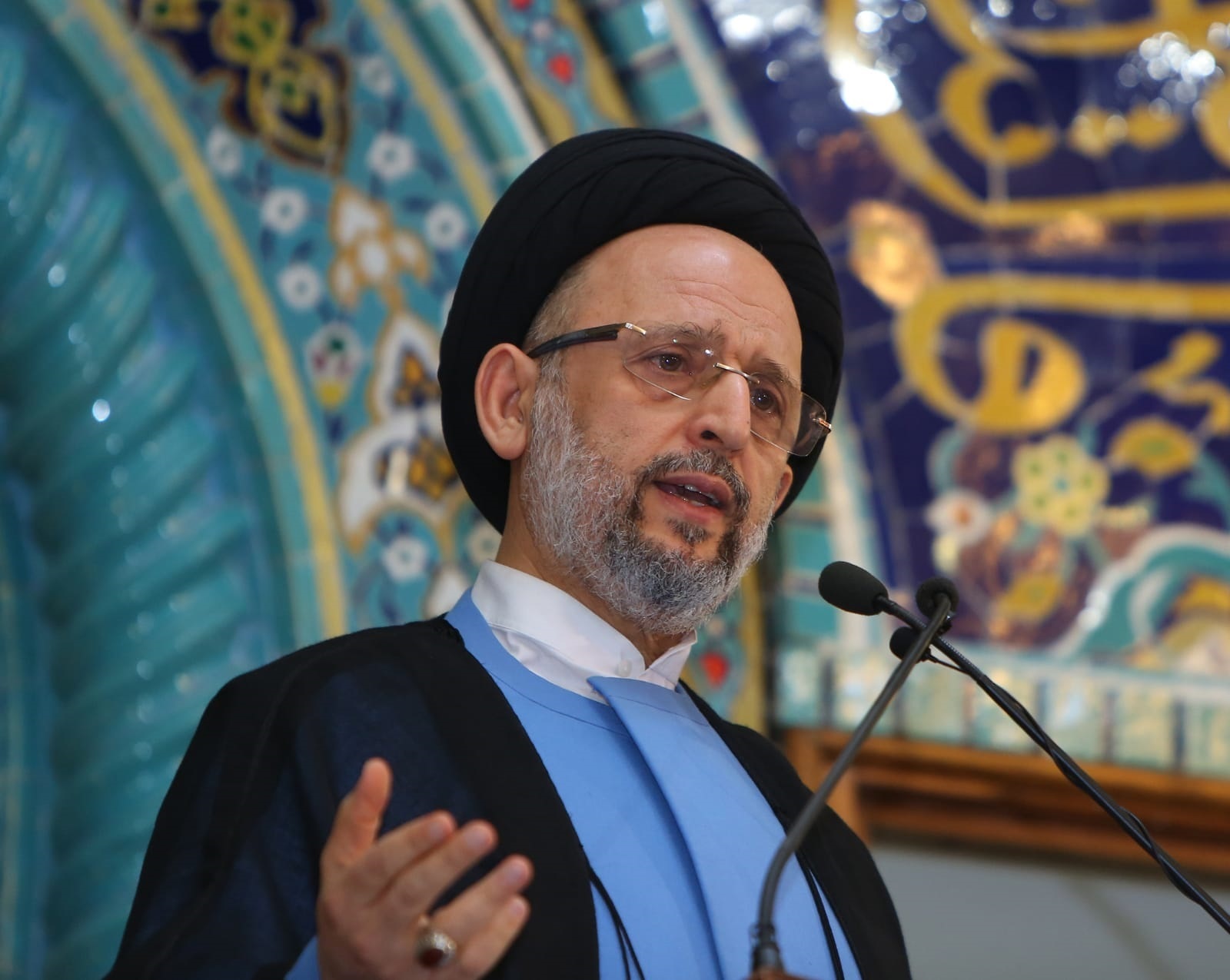
His Eminence, Sayyed Ali Fadlallah, delivered the two Friday prayer sermons at the Imamain Al-Hassanain Mosque; JamadaII 1, 1447H/ November 21, 2025. Several prominent religious scholars, dignitaries and hundreds of believers attended the Jumu’a prayer. Following is summary of his sermons
.
On her death anniversary: Illuminations and lessons from the life of az-Zahrā’ (a.s)
Allah, the Most Exalted, said in His Noble Book:
Indeed, Allah intends only to remove from you the impurity, O Ahl al-Bayt, and to purify you with [extensive] purification.
On the third of Jumāda ath-Thāniyah, we will be with the anniversary of the death of one of those for whom this noble Ayat was revealed — the pure one,Fatima az-Zahrā’ (a.s.), the lady of the women of the worlds, the part of the Messenger of Allah (p.) and his soul between his two sides — based on the narration that her death happened ninety-five days after the death of the Messenger of Allah (p.)
This departure left deep and great pain in the heart of Amīr al-Mu’minīn (a.s.), and in the hearts of her children Zaynab, Umm Kulthūm, al-Ḥasan, and al-Ḥussein (a.s.), and in the hearts of all Muslims — for with her absence, the flow of love and affection she used to pour upon them was absent, and what she offered of advice, guidance, and nurturing stopped, when she used to be the refuge of the hearts of those seeking knowledge and understanding.
Amīr al-Mu’minīn (a.s.) expressed this when he stood at her pure body and said:
It has truly weighed heavily on me to be separated from you and to lose you — but it is a matter that must happen. By Allah, you have renewed for me the calamity of the Messenger of Allah (p.). Your death and loss have grown immense. Indeed, we belong to Allah and to Him we return. What a grievous, painful, cutting, and saddening calamity! By Allah, this is a calamity with no consolation, and a misfortune with no compensation.
And on this painful occasion, we will pause at some of the sayings reported from her (a.s.), to take lessons from them and to make them a provision that helps us in this life.
The first: what was narrated from her by her son, Imām al-Ḥassan (a.s.), when he said:
I saw my mother Fatima (a.s.) stand in her prayer-niche on the eve of Friday, and she remained bowing and prostrating until the column of dawn became clear. I heard her supplicate for the believing men and women, naming them and increasing her prayer for them, and she did not supplicate for herself at all. So I said to her: ‘Mother! Why do you not pray for yourself as you pray for others?’ She said: ‘My son! The neighbor, then the house.
This narration showed the level which Lady az-Zahrā’ (a.s.) reached in her worship of her Lord — standing the night until dawn — as al-Ḥasan al-Baṣrī also said about her:
There was no one in this Ummah more worshipful than Fatima; she used to stand the night until her feet would swell.
And it expressed the extent of her unselfishness toward her neighbors, when she directed her supplication to them — without considering their affiliation or whether they agreed or disagreed with her beliefs — before praying for herself and her children.
And all of us know the importance of supplication made in the absence of the person, as the narration says
“The quickest supplication to be answered is the supplication in the absence of the person”.
The second saying
“Silence is wisdom.”
Lady az-Zahrā’ (a.s.) wanted by this saying to point to the virtue of silence and the wisdom a person reaches when he is silent — for it grants a person dignity, reverence, and safety in his religion and worldly life..
But this does not mean abandoning speech or staying silent from saying the right. A person is required to speak — for with speech the prophets, messengers, and righteous ones came, and through it they called to what they were sent with.
Rather, she meant thinking deeply before speaking — that the tongue should not move except when there is a need, and when the speech is in its proper place and in it is good for others. For if the word is left without limits and boundaries, it may lead to strife, disputes, and wars, and may lead to falling into backbiting, slander, suspicion, useless talk, and harming others’ feelings, opinions, and dignity..
And it is enough to look at reality to see what uncalculated and reactive words cause.
Thus it was said:
“If speech is silver, silence is gold.”
The third saying
The righteous spouse is a help in obedience to Allah.
And it means the husband and the wife together — for the word “zawj” (spouse) applies to both.
She wanted to widen the circle of responsibility upon the spouses: that the role of each spouse should not stop at fulfilling the material, physical, or emotional needs of the other — but in addition to that, each of them should help the other in obeying Allah — reminding them of their Lord, helping them fulfill His commands, avoid His prohibitions, even encouraging recommended acts and avoiding disliked ones.
This is what ensures building a home enjoying spiritual and faith-filled atmosphere, where the father and mother are role models to their children and others — living well in this world and being rewarded in the Hereafter.
Allah, the Most Exalted, said:
Gardens of perpetual residence which they will enter, along with whoever was righteous from among their fathers, their spouses, and their descendants. And the angels will enter upon them from every gate, [saying]: ‘Peace be upon you for what you patiently endured; excellent is the final home.
And the final saying
Whoever obeys Allah is saved, and whoever disobeys Him is destroyed.
She (a.s.) wanted to make clear that the path to salvation in this world is through obedience to Allah, and destruction is in disobedience. For Allah does not command except what has good for the human being, raising him and elevating his level — and He forbids only what is ugly or harmful to the body, to moral and religious values, and to human dignity .Obedience to Allah grants purity of soul, heart, action, and moral elevation — and through it a person receives support, blessings, and provision in this world, as Allah said
{If only the people of the towns had believed and been mindful of Allah, We would have opened upon them blessings from the heavens and the earth. But they denied, so We seized them for what they used to earn.
And it grants salvation in the Hereafter
These are the limits of Allah. And whoever obeys Allah and His Messenger — He will admit him to gardens beneath which rivers flow, abiding therein forever; and that is the great success. And whoever disobeys Allah and His Messenger and transgresses His limits — He will admit him to a Fire wherein he will abide, and he will have a humiliating punishment.
We are in great need, on this painful anniversary, to seek inspiration from az-Zahrā’ (a.s.) — to bring her into our reality, to make her present in us through her life example, her words, her stands, in the fields of worship, knowledge, struggle, purposeful work, and in confronting oppression and deviation.
By that, we become sincere to az-Zahrā’ (a.s.) in the anniversary of her ascension to her Lord. It is not enough for our sincerity to her to express joy on her birth or shed tears on her death or merely recall what she suffered of oppression. She (a.s.) does not stop at that — she wants us to embody her example and to work for the goal for which she endured pain and sacrificed.
Let us ask Allah to help us achieve that, so we may gain her love, her intercession, and the meeting with her in the eternal gardens.
And peace be upon her the day she was born, the day she passed to the presence of her Lord, and the day she will be raised alive — to receive what Allah has prepared of lasting bliss.
In the Name of Allah, the Most Gracious, the Most Merciful
Second Sermon
Worshipers of Allah, I advise you and advise myself with what Lady az-Zahrā (a.s.) advised the women of the Muhājirīn and the Anṣār
Indeed, in Friday there is an hour which, if a Muslim encounters while asking Allah the Most Exalted for good, they will surely give it to them” — of course, if it is in their interest.
She said: “I said: O Messenger of Allah, which hour is it
He (p.) said: “When half of the sun’s disc descends toward setting”.
.
So let us be keen on supplication at this time, so we may attain what we hope for from Allah, and so our hope is that He pushes away from us the trials of this world and the trials of the Hereafter — and thus we become stronger and more capable of facing the challenges of the world and the severity of the Hereafter.
We begin with the Zionist aggressions whose pace has risen in these days to impose a new reality in the expansion of assassination operations, targeting those working in the educational and municipal field,,
— in the return of warnings that happened to many southern villages and their bombing afterwards— and in the massacre that happened in Ayn al-Ḥilwah camp, which claimed dozens of martyrs and wounded
Meanwhile, the enemy continues targeting any sign of life in the villages of the border strip, or any reconstruction projects.
The American administration accompanies these aggressions by imposing more financial, economic and political pressures — expressed in the cancellation of the visit that the army commander intended to make to the United States.
It has become clear that these pressures on the Lebanese state and the Lebanese army aim to push them to hurry in taking the steps required to implement the security interests of the Zionist entity — without considering Lebanon’s own interests, the objective conditions of the army, its limited capabilities, and its keenness to be a factor of stability, not tension.
Meanwhile, the Zionist entity shows no readiness to fulfill its commitments by stopping its aggressions or withdrawing from the positions it still occupies, or returning the Lebanese prisoners from its jails — despite Lebanon’s adherence through its army and its resistance to all the articles of the ceasefire resolution.
Rather, we see this enemy increasing and worsening its aggressions, while also seeking to impose new realities by controlling Lebanese land through the concrete wall it is building at the border — biting off thousands of square meters of Lebanese territory — despite the objection of UN forces that considered it a violation of Resolution 1701, and despite the complaint Lebanon submitted to the Security Council, and with no condemnations from the committee supervising the ceasefire.
Faced by this reality, we reaffirm the need for the government to insist on its position of protecting the security and sovereignty of this country, to mobilize its political and diplomatic efforts and its presence in international forums to shield Lebanon from dangers that may result from Israeli encroachment and the cover it receives.
At the same time, the government must mobilize all the sources of strength it possesses — for there is no security and no sovereignty for Lebanon without a strength that supports it.
We are confident that Lebanon possesses the elements that allow it to remain firm and withstand all the pressure imposed upon it — if it uses them and if its efforts unite.
It is unfortunate that we do not see this unity in confronting what is happening — the violation of land and property and the shedding of citizens’ blood — as if it does not threaten the state or the sovereignty of Lebanon over its land, but only threatens a sect or a group or a political position.
It is dangerous to hear talk — from the highest official position in the state — that there are those working to incite the outside world against the inside of Lebanon, for special interests or factional benefits or to gain the favor of that outside world, without considering that such actions do not harm this position or that group alone, but harm the entire country.
Those who do this must realize that the outside world works only for its own interests — not for any sect or faction — and those who become tools in its hands will eventually be discarded, because no outside force respects those who are not loyal to their homeland and its sovereignty.
We reaffirm to all political forces and leaders the necessity of supporting the Lebanese Army and standing with it as it works tirelessly to ensure social and moral security and everything that threatens the safety of the Lebanese — to help reduce the sacrifices it bears from its members and from the Lebanese people, as we witnessed recently.
Inside the country, we reaffirm that the government must not forget, amid everything happening, what it owes to its citizens — especially in living conditions, which worsen day after day — and to hasten to return the deposits of the people, and to rebuild, which must be among its top priorities, and to advance reforms that we want to be an internal decision, not something Lebanon is pushed toward.
Finally, on the Independence Day anniversary, we renew the call for all Lebanese to safeguard this national achievement — by deepening the spirit of independence within themselves, especially as it faces one of its most difficult challenges in this stage — by uniting their efforts and standing together against everything that threatens the independence, freedom, and sovereignty of this land.
We should also remember, on this day, those heroes who protected and continue to protect independence with their blood, and who offered great sacrifices so that Lebanon remains, as we want it, sovereign, free, and independent.
.