
The Believer’s Responsibility in a Time of Media Deception
:
In the name of Allah, the Compassionate, the Merciful
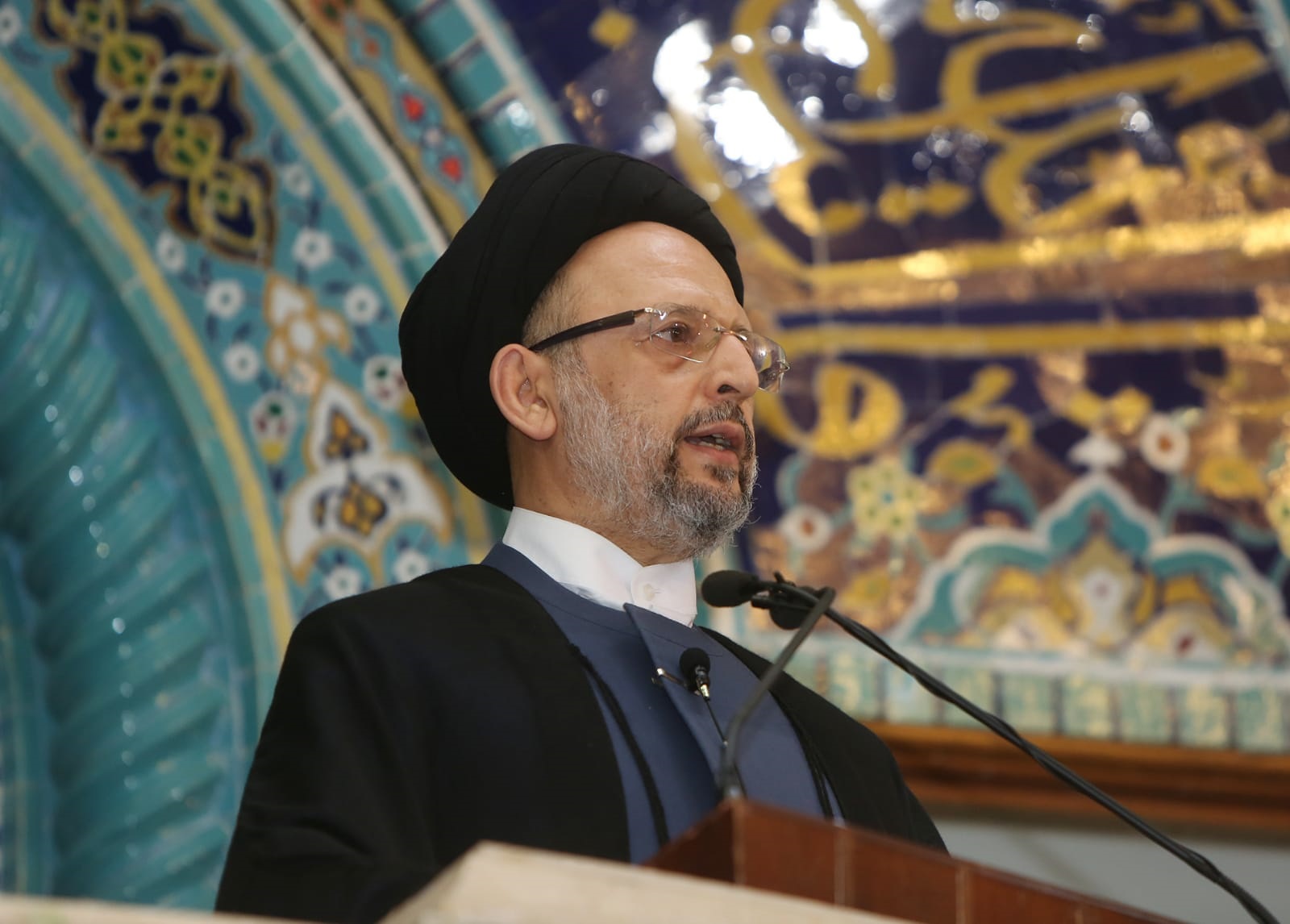
His Eminence, Sayyed Ali Fadlallah, delivered the two Friday prayer sermons at the Imamain Al-Hassanain Mosque; JamadaI 23, 1447H/ November 14, 2025. Several prominent religious scholars, dignitaries and hundreds of believers attended the Jumu’a prayer. Following is summary of his sermons
The Believer’s Responsibility in a Time of Media Deception
God, the Most Exalted, says in His Glorious Book: “And do not pursue that of which you have no knowledge. Indeed, the hearing, the sight, and the heart—about all those [one] will be questioned.” Allah ,The Most Exalted, has spoken the truth.
We all have come to know the impact of media pumping, created by media outlets and social-media platforms, on our opinions, orientations, and ideas—especially after their wide spread—where the right may mix with the false, and the true with the untrue. This calls us to review everything that reaches us, so that we do not allow those who want to manipulate us to have the freedom to do so, and so that we do not end up saying on the Day of Resurrection: “They will say: Our Lord, we obeyed our chiefs and our great ones, and they misled us from the way.
Islam has been keen to build this awareness in us and to root it deeply, so that we do not become prisoners of our desires, fanaticisms, emotions, and of those who wish to tamper with us. Thus, we will pause here at some of the guidance mentioned in this field, based on Qur’anic Ayats and noble sayings:
The first of these guidances is careful examination and confirmation —that we do not rush to accept everything that reaches us before we checking and verifying what we have heard or read. This is what Allah, the Most Exalted, pointed to when He said: “Man was created of haste. I will show you My signs, so do not be impatient.
It is narrated from the Messenger of Allah (p.): “People were destroyed only by haste; and had they verified, no one would have perished.” And it is narrated from the Commander of the Faithful, ‘Ali (a.s.): “With haste, slips become many
The Qur’an presented an example that teaches us how to deal with any news that reaches us—namely the way Prophet Sulaiman (a.s.) dealt with the hoopoe when he came saying: “Indeed, I found a woman ruling over them, and she has been given of everything, and she has a great throne. I found her and her people prostrating to the sun instead of God; and Satan made their deeds seem beautiful to them, and barred them from the path, so they are not guided.
Prophet Sulaiman (a.s.) did not rush to believe the hoopoe or to act upon what he brought, although he was close to him. Instead, he said: “We will see whether you have told the truth or are of the liars.” When he verified what he said, he built his position toward that people accordingly.
The second guidance is to pay close attention to the source of any news, information, idea, or opinion—to make sure first that it truly came from where it is said to have come, and then to verify the reliability of the one who transmitted it, his accuracy, his relations, his connections, and what goals he is pursuing through transmitting it. Does it serve good? Or is he aiming to distort facts and twist minds? God says: “O you who believe, if a wicked person comes to you with news, verify, lest you harm people out of ignorance and then become regretful for what you have done.
It is narrated in the reason of revelation of this Ayat that a man among the companions of the Messenger (p.), Al-Walid ibn ‘Uqbah, was sent by the Prophet (p.) to the tribe of Banu Al-Mustaliq to collect Zakat. When he reached them, they went out to receive him because he was sent by the Messenger, and to answer his call to pay Zakat. However, because of the enmity between him and them, he imagined that they wanted to kill him. Without verifying, he returned to the Messenger (p.) and told him that Banu Al-Mustaliq refused to pay Zakat. The Messenger(p.) did not rush to act on that news, but sent someone to verify it. It then became clear that what he had said was not true. Had the Prophet (p.) not verified and had he acted on the report, he would have wronged them, and that would have led to fighting them for refusing to carry out the Prophet’s orders and the laws of the Islamic state he led.
The third guidance is to be very cautious of those who master the art of speech or the crafting of images and videos, and who have the ability to influence, using that ability to mislead people and corrupt their lives. Allah, the Mighty and Majestic, says: “And among the people is he whose speech amazes you in worldly life, and he calls God to witness what is in his heart, yet he is the fiercest of opponents. And when he turns away, he strives through the land to spread corruption in it and destroy crops and offspring; and God does not love corruption.
This Ayat calls us not to fall into the trap of such people, and to look deeply into their goals, not merely at their words.
Many today use polished and decorated speech under the pretext of zeal for the homeland, religion, sect, people, or this group or that—while their real goals are personal .interests and selfish gains. We should weigh everything that reaches us by the standards of reason, knowledge, logic, and religion—away from desires, fanaticisms, general atmospheres, or what suits our emotions and interests. We should take only what we are sure is true, logical, real, and verified. Allah, the Exalted, says: “And do not pursue that of which you have no knowledge. Indeed, the hearing, the sight, and the heart—about all those one will be questioned.” And He says: “O you who believe, avoid much suspicion; indeed some suspicion is sin.”
Among the clearest expressions is what was narrated from the Messenger (p.). When asked how one should accept what others bring, he said: “Like this”—and the sun at that time was shining clearly—“so bear witness, or leave it.
As for the one who does not have the ability to judge news and scrutinize it, he is not excused if he errs; rather, he must return to those who have knowledge—those who possess experience and understanding .Allah says: So ask the people of knowledge if you do not know
My loved ones, God wanted us to be aware in this life—seeking truth always. This requires that we have a conscious hearing, a conscious sight, and a conscious mind that scrutinizes everything. By this, we will not fall into the traps of others or become victims of positions caused by false ideas and wrong information—positions we may later need to apologize for or retract. Rather, all of that should be a door to increased awareness.
Islam calls us to reach this level of awareness, and to always remember that we are responsible before God. We should follow what Imam Zayn al-‘Abidin (a.s.) advised when he said
“As for the right of the hearing, it is to keep it away from listening to backbiting or anything unlawful, and to make it a path to your heart for noble words that bring good into your heart or earn you a noble character; for the ear is the door of words to the heart… And as for the right of sight, it is to lower it from what is not lawful for you, and not to use it except for a place of lesson from which you take insight or learn knowledge; for sight is the door of reflection…
May Allah make us among those who “listen to speech and follow the best of it.” And our final prayer is that all praise belongs to God, Lord of the worlds.
The Second Sermon
In the name of Allah, the Most Merciful, the Most Compassionate
Worshipers of Allah, I advise you and myself with what the Messenger (p.) advised that companion who came asking for an advice. The Messenger (p.) told him: “Do not get angry at all, for anger contains disputing with your Lord.” He said: “Give me more.” He replied: “Beware of what requires apology, for it contains hidden shirk.” He said: “Give me more.” He replied: “Pray as if you are bidding farewell, for it contains connection and closeness.” He said: “Give me more.” He replied: “Be shy before God as you are shy before your righteous neighbors, for that increases certainty.
And Allah, the Most Exalted, has summarized what all former and later people advise each other with in one trait: taqwa. He said: “And We certainly enjoined those who were given the Scripture before you and you, that you practice taqwa of God.”:
Through taqwa, those who truly lived with Allah lived a good life and remained constantly close to Him.
Allah, the Most Exalted, , said: “Indeed, the God-conscious will be in gardens and rivers, in a seat of truth near a Sovereign, Perfect in Ability.
Let us hold fast to the advices of the Messenger (p.), so that we gain their results in this world and the next, and so that we become more aware, responsible, and capable of facing challenges.
We begin with the Israeli attacks, which appear to have no intention of stopping—shown in the airstrikes on the South and the Beqaa, the assassinations that targeted Lebanese citizens during their movements or inside their villages, and the explosions of buildings in the border-strip villages to complete the enemy’s goal of emptying them of their residents, along with the continuous intimidation carried out by drones flying over Lebanese areas.
All of this is accompanied by escalating threats from Israeli political and security leaders about an upcoming war on Lebanon. This happens under the eye of the committee responsible for monitoring the ceasefire and guaranteeing its implementation—a committee that restricts its role to watching the Lebanese Army’s performance in implementing the plan to limit weapons south of the Litani, without taking any step to stop the enemy’s daily attacks or making any effective decision against them, though it is capable of doing so.
It has become clear that all these attacks are part of the pressures placed on Lebanon to force it to give in to the enemy’s conditions which violate its sovereignty, security, and freedom of decision—by stripping Lebanon of the weapons feared by the enemy, accepting the creation of a buffer zone at the border, and granting the enemy complete freedom of movement throughout the Lebanese territory to face any threat it claims affects its security—along with other conditions that may not yet have been announced.
From here, we renew our call to the Lebanese state to carry out the role required of it in protecting its citizens, their properties, and its sovereignty over its land. This includes calling the countries sponsoring the ceasefire to pressure the enemy to fulfill its commitments: stopping attacks, returning prisoners, and stopping its policy of preventing reconstruction—after Lebanon fulfilled what is required from it under the ceasefire agreement.
At the same time, the state is responsible for activating its diplomacy in international forums to expose the enemy’s violations and clarify the dangers resulting from the continuation of its attacks. Here, we call on Arab states to use all the pressure tools they possess to stop the ongoing Zionist aggression on Lebanon, just as they acted in Gaza.
Therefore, we call on the government to carry out its duty to strengthen its presence among its citizens, reinforce their trust in it, and make them feel that it is a government capable of protecting them and relieving their suffering—by activating its efforts in security, politics, economy, and finance, to improve the conditions of the Lebanese and rescue them from what they are suffering in these fields, leading them to safety within the limits of what is available.
It is unfortunate to witness unjustified delay on this level, which gives outsiders excuses to impose on this country what serves their interests in issues of reform in the sectors of security, finance, economy, and politics—at the expense of Lebanon.
At this time, we renew our call to the Lebanese—immersed in their disagreements—to unite in this stage, to face the dangers surrounding their country in its sovereignty, security, and freedom, and the challenges seen at the border or planned abroad, which naturally reflect on Lebanon. They must approach these dangers with pure national spirit—not with narrow sectarian or factional considerations.
It is unfortunate to witness all this storm of tense, hurtful, provocative words, which give the enemy excuses to continue its aggression and maintain its occupation. Let us stop turning our words and positions into weapons used against each other, instead of directing them toward those who wish to tamper with our security, politics, and land—those who benefit the most from our differences and achieve their goals at our expense.
We reach Gaza, where the Zionist enemy continues to evade its commitments to a complete ceasefire and the delivery of aid to the people of the Strip—an evasion it continues in the West Bank through attacks, arrests, economic siege, settlement expansion, and the passing of unjust laws against the people. All of this should push Arabs, Muslims, and all free people to stand with this people and not leave them prey to a plan aiming to displace them and bring an end to the Palestinian cause….

You may also like
The Responsibility of Speech in Times of Challenges