
The Tasbih of al-Zahra (a.s.): Nourishment for the Soul in Facing Life’s Hardships
In the name of Allah, the Compassionate, the Merciful
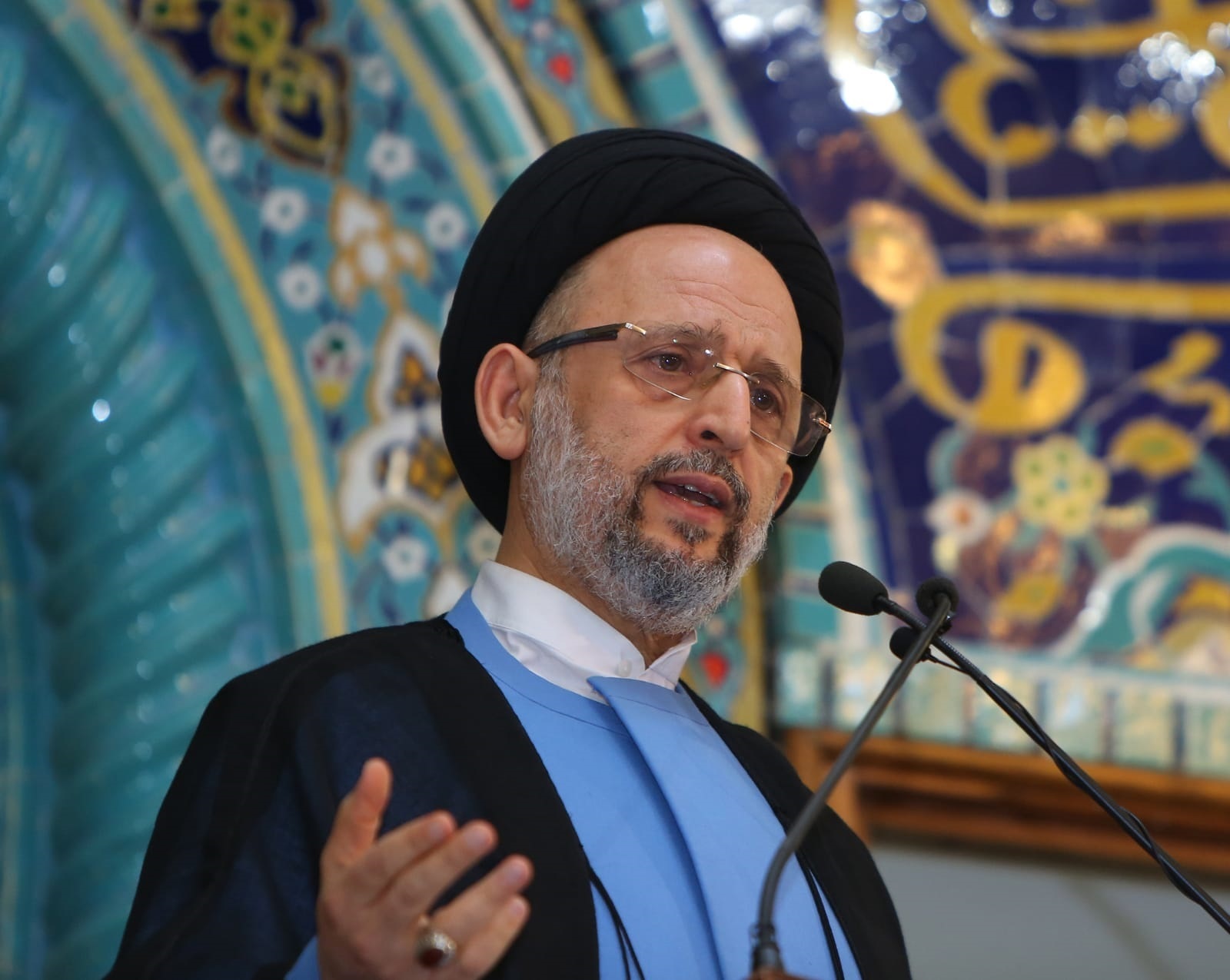
His Eminence, Sayyed Ali Fadlallah, delivered the two Friday prayer sermons at the Imamain Al-Hassanain Mosque; JamadaI 9, 1447H/ October 31, 2025. Several prominent religious scholars, dignitaries and hundreds of believers attended the Jumu’a prayer. Following is summary of his sermons
The Tasbih of al-Zahra (a.s.): Nourishment for the Soul in Facing Life’s Hardships
Allah, the Most Exalted, says in His Glorious Book:
“Indeed, Allah desires to remove all impurity from you, O People of the House, and to purify you completely.”
Allah, the Most Exalted, speaks the Truth.
We are today in the thirteenth of Jumada al-Awwal, the anniversary of the passing of one in whom Allah’s will was fulfilled by removing impurity from the People of the House and purifying them completely: the truthful and pure Fatimah al-Zahra (a.s.), Lady of the Women of the Worlds. According to the narration we rely upon, her passing occurred on this day, seventy-five days after the death of the Messenger of Allah (p.).
This painful anniversary struck the hearts of Ali, Zainab, Hassan, Hussein, and Umm Kulthum (a.s.), renewing their grief for the Messenger of Allah (p.). Ali (a.s.) expressed this grief when he stood by her grave and turned toward the Messenger (p.), saying:
“Speak, O Messenger of Allah, of my patience in facing the loss of Your chosen one, and of my endurance through her separation except that in emulating your great separation and your grievous loss, there is a place for consolation. Indeed, to Allah we belong and to Him we shall return … As for my sorrow, it is endless, and my nights sleepless, until Allah chooses for me the abode in which You reside.”
Today, we recall part of her life. It is narrated that Ali (a.s.), upon seeing her exhaustion and fatigue, asked: “What if we went to your father to request a servant to ease your burdens?” But she (a.s.), out of modesty toward the Messenger (p.), refrained from making this request herself. So when they reached the Messenger (p.), Ali (a.s.) spoke to him:
“O Messenger of Allah, your daughter drew water until it affected her chest, ground grain until her hands were raw, swept the house until her clothes were dusty, and lit the fire under the pot until her garments were soiled.”
The Messenger of Allah (p.) wept upon seeing his daughter so weary and burdened. Although he did not wish to deprive her from a servant; he desired something greater for her. He instructed her and Ali (a.s.), who shared household responsibilities, saying:
“Shall I not teach you what is better than a servant? When you sleep, glorify Allah thirty-four times, praise Him thirty-three times, and say ‘SubhanAllah’ thirty-three times.”
Fatimah (a.s.) said: “I am content with Allah and His Messenger,” and Ali (a.s.) agreed. Thus, this Tasbih became their practice, repeated at bedtime and after each prayer, relieving them of the burdens of housework and life.
The Messenger (p.) intended several lessons through this Tasbih:
First: He sought to honor his daughter, Fatimah (a.s.), whom he cherished. He said:
“Fatimah is my soul; whoever angers her angers me, and whoever harms her harms me. Fatimah is the mother of her father.”
By guiding her to this Tasbih, he elevated her rank before Allah and ensured her remembrance through generations. Imam al-Sadiq (a.s.) said:
“No act of glorifying Allah after prayer is better than Fatimah’s Tasbih; if there were, the Messenger of Allah (p.) would have passed it to Fatimah.”
It is narrated that the Messenger instructed children:
“We command our boys to perform Fatimah’s Tasbih as we command them to pray,” emphasizing the importance of instilling prayer in upbringing.
Second: He indicated the role of Tasbih in facing challenges and difficulties, as exemplified by Prophet Yunus (a.s.) in the belly of the whale:
“And [mention] the man of the fish, when he went off in anger and thought We would not decree anything upon him. And he called out in the darkness: ‘There is no deity except You; exalted are You. Indeed, I have been of the wrongdoers.’ So We responded to him and saved him from distress.”
“Had he not been of those who glorify Allah, he would have remained in its belly until the Day they are resurrected.”
Similarly, Allah commanded the Prophet (p.) to Tasbih in response to challenges:
“So be patient over what they say and exalt [Allah] with praise of your Lord before the rising of the sun and before its setting, and during part of the night, exalt Him and at the ends of the day, that you may be satisfied.”
Third: The Messenger (p.) intended to highlight the educational role of Tasbih. It should arise from the heart, reflect in life, and guide behavior, as
Allahu Akbar (34 times) reminds one that Allah is greater than all creation; no power or status surpasses Him.
Alhamdulillah (33 times) expresses gratitude for Allah’s favors and encourages reciprocating His blessings by avoiding sin.
SubhanAllah (33 times) declares Allah’s perfection and purity from all defects.
It anchors the believer in reliance on Him, as expressed in Dua:
“O my Master, You are my sole recourse in need, before anyone else. None shares in my hope or my invocation. You alone have power and sovereignty; all else is powerless.”
This is but a glimpse of her legacy. Our devotion to her should not stop at tears or mourning gatherings, but should reflect in emulating her personality, her role in her household and society, and her stance against injustice. By doing so, we honor her and are worthy of her name.
.
Second Sermon
In the name of Allah, the Most Compassionate, the Most Merciful.
O worshipers of Allah, I advise you, and I advise myself, with what Fatima (a.s.) advised that man who came to her and said: ‘O daughter of the Messenger of Allah (p.), did the Messenger of Allah (p.) leave anything with you for me to take?’ She said: ‘O servant girl, bring that porridge.’ He asked for it but could not find it. Then Lady Fatima (a.s.) said: ‘Woe to you! Bring it, for it equals, in my view, Hassan and Hussein.’ He brought it, and when she opened it for the man, it contained: ‘None of the believers is one from whom his neighbor feels unsafe. Whoever believes in Allah and the Last Day must not harm his neighbor, and whoever believes in Allah and the Last Day should speak good or remain silent. Allah loves the generous, forbearing, and modest, and He hates the obscene, miserly, and the beggar who exaggerates in asking for charity. Modesty is part of faith.’
We are in greatest need to bring all these meanings to mind, to correct the image of the believer within ourselves—whose role does not stop at performing formal rituals, but reflects in their behavior toward their neighbors and society. In this way, we build an ideal community, making ourselves more present, effective, and capable of facing challenges.
The beginning is with the Israeli attacks we witnessed over the past week on Lebanon, through airstrikes targeting the Bekaa and the South, assassinations, and continued incursions into villages along the border strip. The latest of these was the destruction of the Al-Udaysa Hussainiya, the heinous crime committed by the enemy in storming the municipality building in Blida, killing one of its employees in cold blood, and the continued targeting of vehicles used for reconstruction, aimed at preventing the rebuilding of what was destroyed by their aggression. All of this occurs in the context of the committee tasked with supervising the ceasefire failing to play its role in deterring the enemy from its attacks, alongside the pressures being exerted on Lebanon, which seem likely to continue both security-wise and economically, until Lebanon submits to the enemy’s conditions for direct negotiations—a plan the U.S. envoy sought to promote through the mechanism she proposed.
It has become clear that the negotiations the government is invited to engage in are not intended to end the ongoing state of war or restore stability to this country. If that were the true goal, it would have happened since the ceasefire decision, which the Lebanese state fully adhered to, along with the resistance. Evidence of this is the lack of response to the enemy’s repeated aggressions, which have so far led to the martyrdom of more than 360 people. But it has become clear that this enemy does not want a solution through negotiation; rather, it seeks a way to cement and legitimize the status quo, ensuring its dominance in Lebanon and gaining security advantages, including imposing on Lebanon a buffer zone whose limits may expand… and its conditions may extend to achieving other political and security goals, some announced, some unannounced.
In this regard, we call on the Lebanese state not to approach negotiations from a position of weakness, assuming Lebanon has no option but to comply. It must insist on its stance before all countries calling for negotiations to end the state of war, after Lebanon has fulfilled its obligations, and press the enemy to fulfill its commitments, stop its attacks, respect Lebanese sovereignty, withdraw from occupied sites, and return the Lebanese prisoners.
We do not seek to underestimate the enemy’s capabilities or the international cover it enjoys, but this, as we said before, does not justify submitting to its conditions or compromising the country’s sovereignty and security. Rather, it calls for strengthening internal resilience and ensuring external conditions to protect the country from the enemy’s ambitions and aggression.
Here, we must highlight the responsible national stance taken by the President of the Republic, who called on the army command to respond to any attack by the Zionist enemy on Lebanese territory. This restores the army’s role in protecting the Lebanese and defending the homeland. We have always emphasized that the army is capable of fulfilling this role if provided with the necessary capabilities, means, and political cover.
Therefore, we renew our call to all Lebanese not to succumb to intimidations or pressures at this stage, which aim to weaken their internal resilience and push them to make the concessions the enemy wants, seeking through intimidation what it could not achieve through war. This does not mean neglecting caution toward the enemy; caution is required at every stage. Meanwhile, we renew our call to all Lebanese, in this critical stage of their history, and facing challenges affecting their security and sovereignty, to strengthen their unity in confronting these dangers, and to refrain from anything that undermines it, for unity is their main asset by which they prevent anyone from tampering with their security and destiny. The path to achieving and consolidating this unity is through adopting the language of dialogue to contain any disagreements.
It has become clear that consensus is what guarantees security, stability, and unity, for this country cannot be stable by force. Therefore, and in light of the disagreement over the electoral law, which has taken sectarian and confessional dimensions and may disrupt the upcoming electoral deadline, all efforts must be exerted to find a consensual formula that preserves the right of expatriates to vote, without turning this entitlement into a field for internal score-settling, undermining national balances, or creating internal division.
Returning to Gaza, the enemy resumed its airstrikes, leading to the fall of many martyrs and wounded, claiming that the resistance in Gaza did not fulfill its commitment, without providing any convincing evidence. This indicates the enemy’s continuing project to destroy Gaza and displace its people, fabricating pretexts to justify its ongoing pursuit of this project. This calls on the countries sponsoring the agreement to assume their responsibility to compel the enemy to fulfill its pledges.
We call on the Palestinian people to remain steadfast, patient, and resilient, to prevent the Zionist entity from achieving its goals and to realize what it seeks in Gaza, which it continues to pursue actively in the West Bank.

You may also like
The Believer’s Responsibility in a Time of Media Deception
The Responsibility of Speech in Times of Challenges